
When Strategic Cultures Collide: The Cultural Logic Behind the Iran Crisis
Why Israel, the United States, and Iran may be interpreting the same events through entirely different civilisational lenses

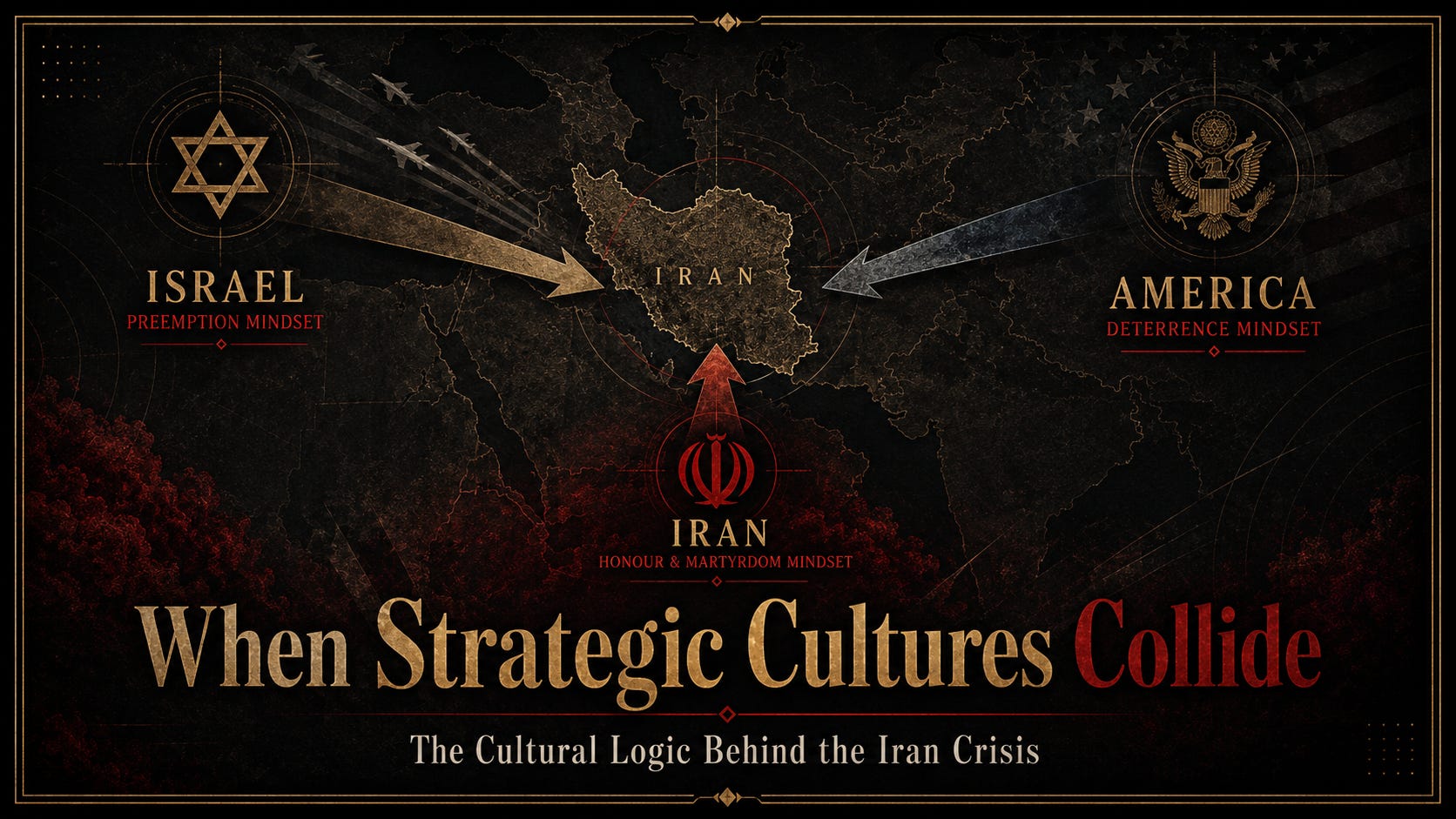
On 28 February 2026 a joint American and Israeli operation killed Ali Khamenei, who had led Iran since 1989, along with members of his family and much of the senior command. The American framing presented the strike as a liberation. Iranians would seize the moment to reclaim their country, and a system built around the Supreme Leader would fall once its head was removed.
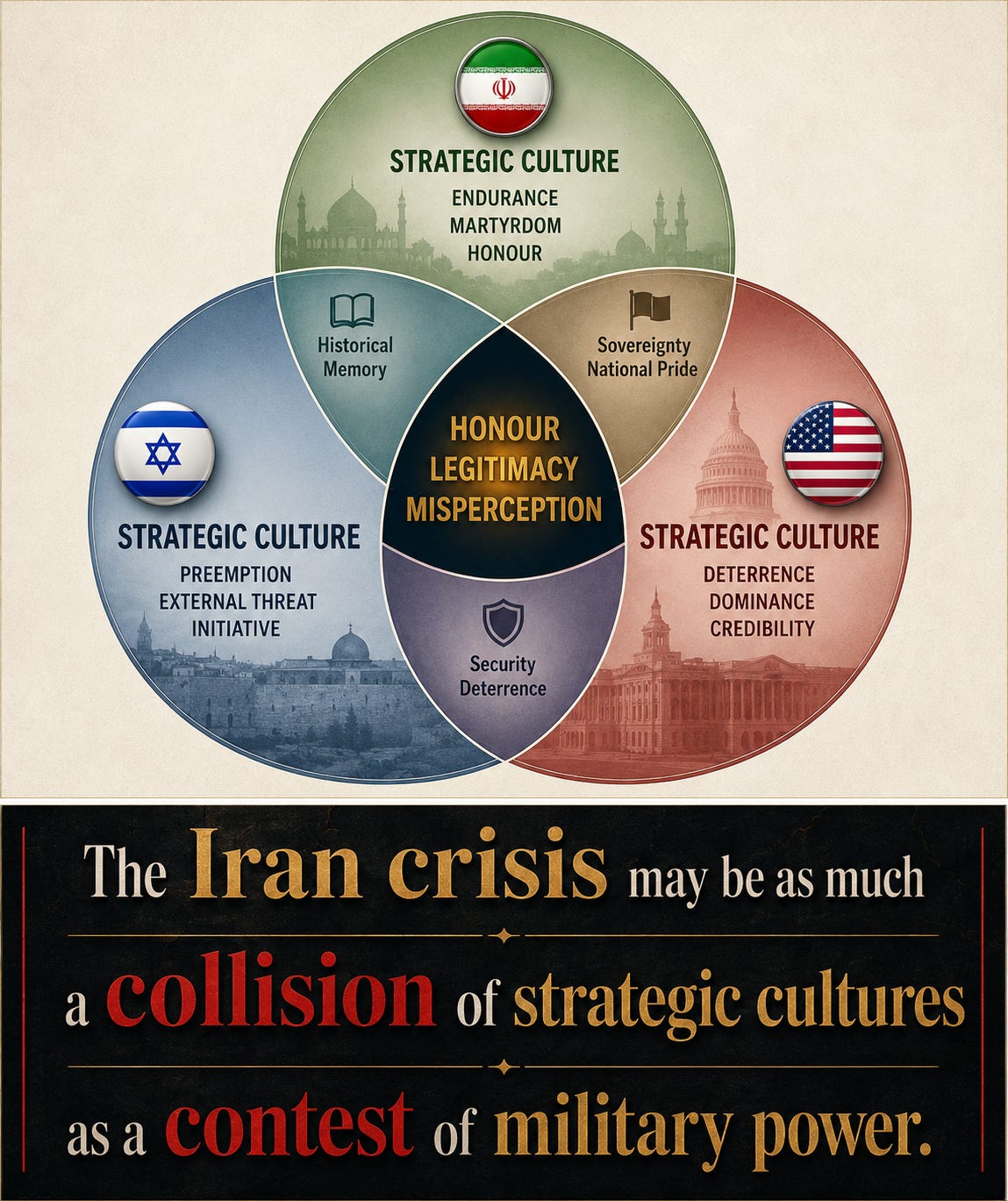
The months since have run another way. The government held. An interim council formed within a day, and Khamenei’s son Mojtaba was advanced as successor. Mourning crowds filled the streets. Iran’s retaliation arrived faster and heavier than its careful reply of the previous summer. The war spread across the Gulf, shipping through the Strait of Hormuz fell to almost nothing, and oil rose above a hundred dollars a barrel. The assumption behind the strike, that removing the leader would remove the threat, looks more and more like a misreading.
Most accounts of the crisis reach for two familiar vocabularies. Western strategists talk about deterrence, the calculus of threats and capabilities. Regional commentators talk about power, the contest for primacy across the Middle East. Both capture something real. Both leave out the variable that explains why the same events keep producing opposite reactions. The missing variable is meaning.
Wars do not escalate merely because states possess weapons. They escalate because states assign different meanings to the same actions.
A strike that one side reads as deterrence, another reads as humiliation, and a third reads as the making of a martyr. The weapons are identical. The interpretations are not, and the interpretations decide what happens next.
Three cultures, three starting points
Israeli strategic culture begins with bluntness. The society prizes a manner of speech it calls *dugri*, a borrowed Arabic word for talking straight, and the same directness runs through its security thinking. A state with almost no strategic depth cannot rely on surviving the first blow, so its doctrine favours initiative and preemption, captured in a recurring question: “If the threat is growing, why wait?” Applied to Iran, the disposition generated a threat assessment stated in maximal terms and delivered without softening. That framing shaped how Washington came to define the problem.
American strategic culture reaches instinctively for deterrence and coercion. Force is treated as a message, calibrated to change an opponent’s cost-benefit calculation. Pressure, on this view, produces concessions, and the removal of a hostile leader counts as coercive success. Iran’s weakened position after the June 2025 war, the sanctions, the protests and the damaged network of allies, read in Washington as evidence that the pressure was working and that military means now offered more than diplomacy.
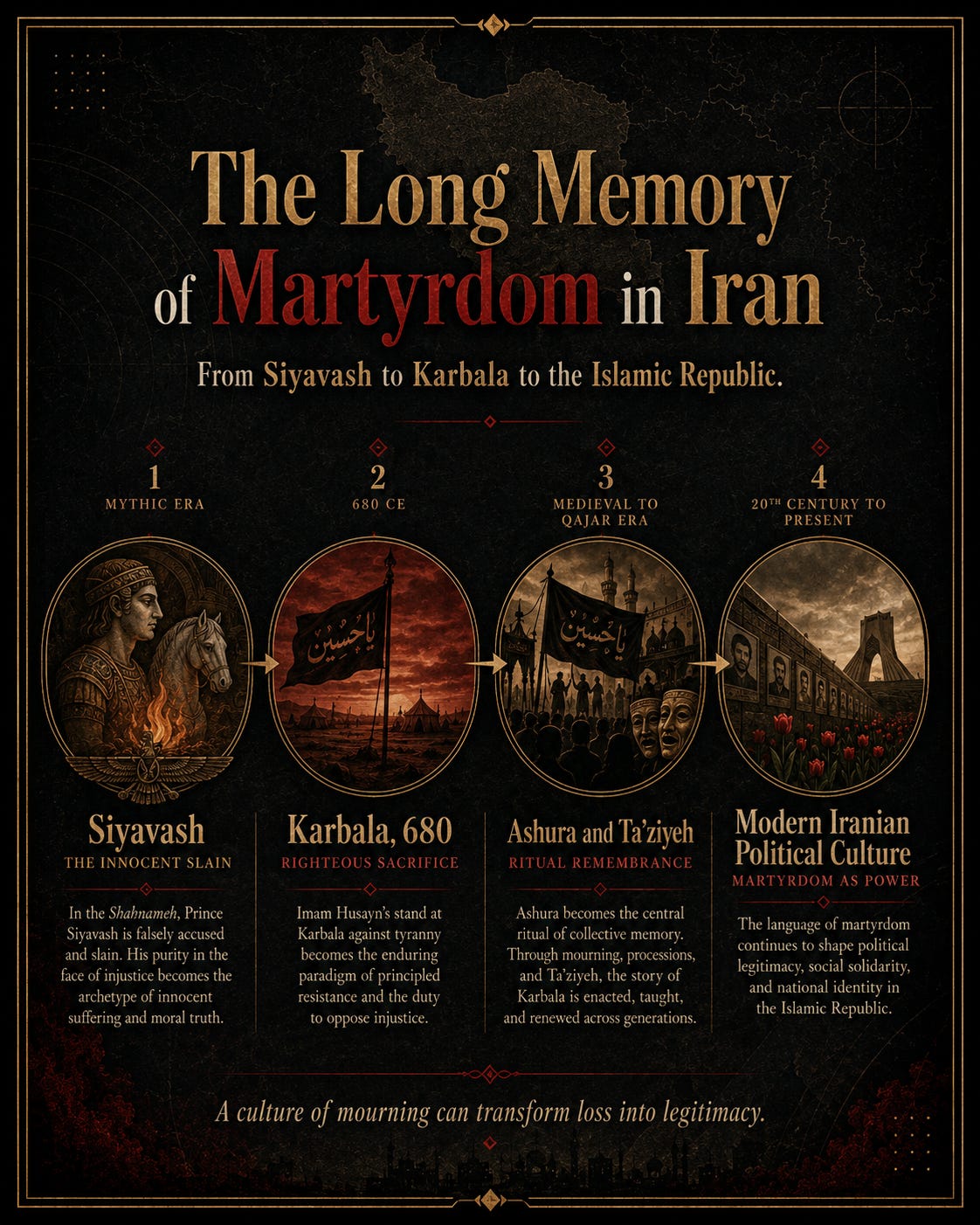
Iranian strategic culture rests on two older foundations. The first is a long tradition of honouring the righteous victim, running from the ancient mourning for the slain prince Siyavash to the central Shia commemoration of Husayn, killed at Karbala in 680 and grieved every year since. A system grounded in that tradition tends to convert the killing of a leader into a martyrdom that strengthens cohesion rather than breaking it. The second foundation was patience. For all his revolutionary language, Khamenei governed with caution, and his responses to direct attack were calibrated to satisfy honour while avoiding a war that might end the system. After the United States killed Qassem Soleimani in 2020, Iran struck back at American bases with enough advance signalling to limit casualties, which let both sides retreat. A patient centre kept Iranian reactions inside predictable bounds.
Three Cultures, Three Interpretations
The collision becomes clearer when the same events are read through each lens at once.
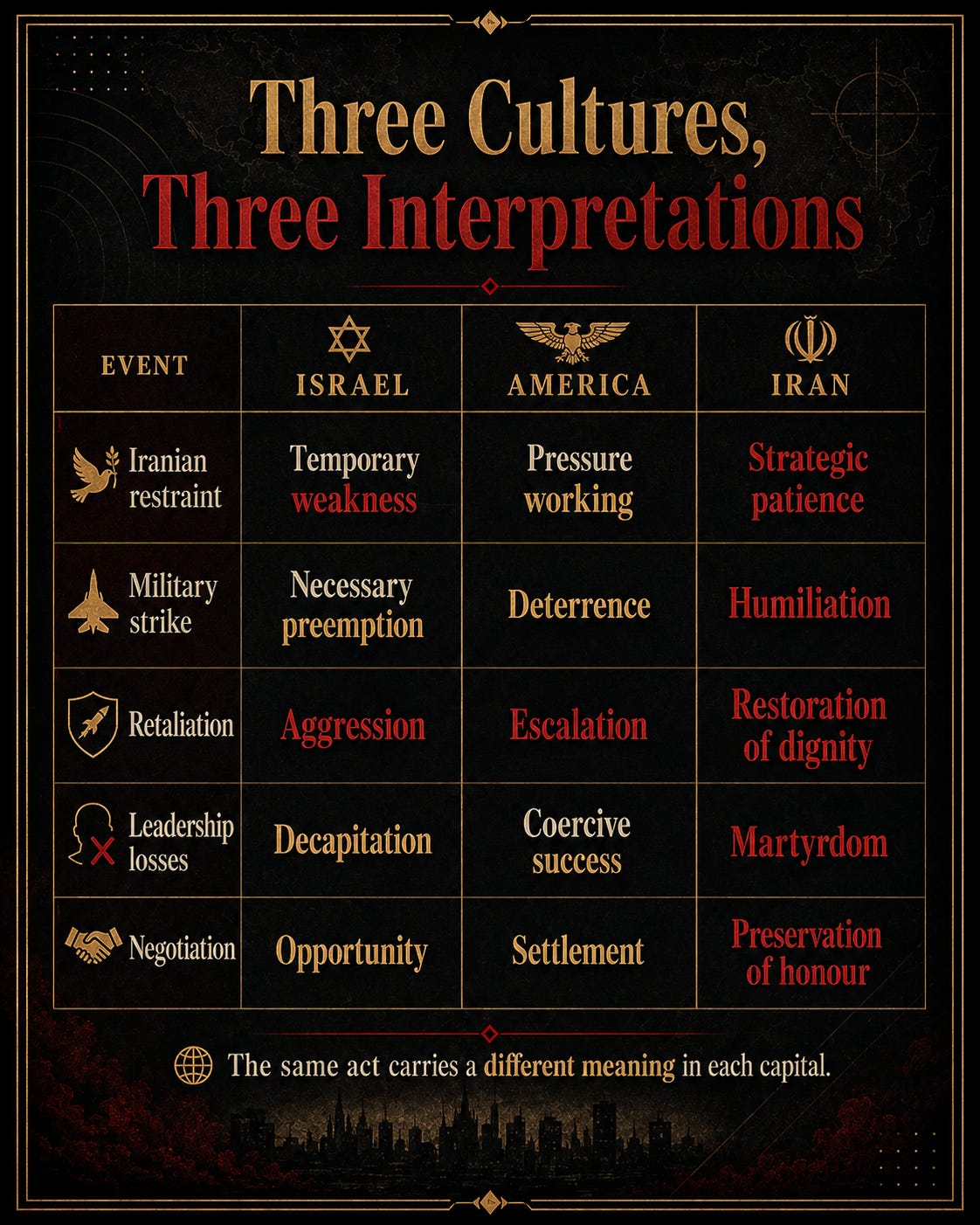
Three Read down the columns, three coherent worldviews appear. Read across the rows, the danger appears. The same act carries a different meaning in each capital, and each meaning licenses a different response.
Iranian restraint that Washington files under pressure working is filed in Tehran under strategic patience, a reserve of dignity rather than a sign of surrender.
A strike that Israel records as necessary preemption is recorded in Iran as humiliation demanding redress.
Leadership losses that the coalition counts as coercive success register in Iran as martyrdom, the most mobilising category its culture contains.
None of the three sides is reading the situation irrationally. Each is reading it correctly by its own grammar, and the grammars do not match.
The Missing Variable: Humiliation
Western strategic literature is built around power, interests, deterrence and capability. It leaves little room for humiliation, and humiliation sits close to the centre of Iranian political memory. The catalogue is long: the 1953 coup that removed the elected prime minister Mohammad Mossadegh with American and British help, decades of sanctions and enforced isolation, the 2020 killing of Soleimani, repeated strikes on Iranian soil, and now the death of the Supreme Leader. Each episode entered the national story not only as a loss of capability but as an injury to standing.
Recent analyses of the June 2025 war have framed its aftermath in exactly these terms, treating the regime’s exposure as a wound to honour as much as a military setback. The distinction matters for what follows. A state that has been humiliated does not calculate the way a state that has merely been deterred does. Its first priority becomes the restoration of dignity, and restoration can be valued above safety.
Culture shapes far more than how people communicate. It shapes how they read status, respect and legitimacy.
The Iranian reply to the February strike supports the reading. It came faster and in greater volume than the measured response of the previous summer, and in its opening days Iran launched a larger share of attacks than across much of the earlier twelve-day war. Analysts have taken the shift as a sign that the command structure, and its old caution, had changed.
That change is the heart of the matter. The strike removed the figure most responsible for keeping Iranian retaliation bounded, and it did so in the name of reducing the Iranian threat.
The patient calculator is gone. Left behind are a martyrdom culture, a deep memory of humiliation, and a dispersed command with less to lose. The combination tends to escalate, not fold. A strike calculated purely in the language of capability can land as an assault on status, respect and legitimacy at once, and a state reacts to that kind of injury with far less restraint than a cost-benefit model predicts.
Built to survive decapitation
The speed of the Iranian reply also has a structural explanation, and it points to a second American misreading. Iran had seen decapitation before, and it had prepared for it. The lesson came from Iraq. The rapid collapse of Saddam Hussein’s heavily centralised state
in 2003, and the wider pattern of American operations against centralised regimes, persuaded Iranian planners that a single command centre was a fatal weakness. The killing of Qassem Soleimani in Baghdad in 2020 drove the point home on Iranian flesh.
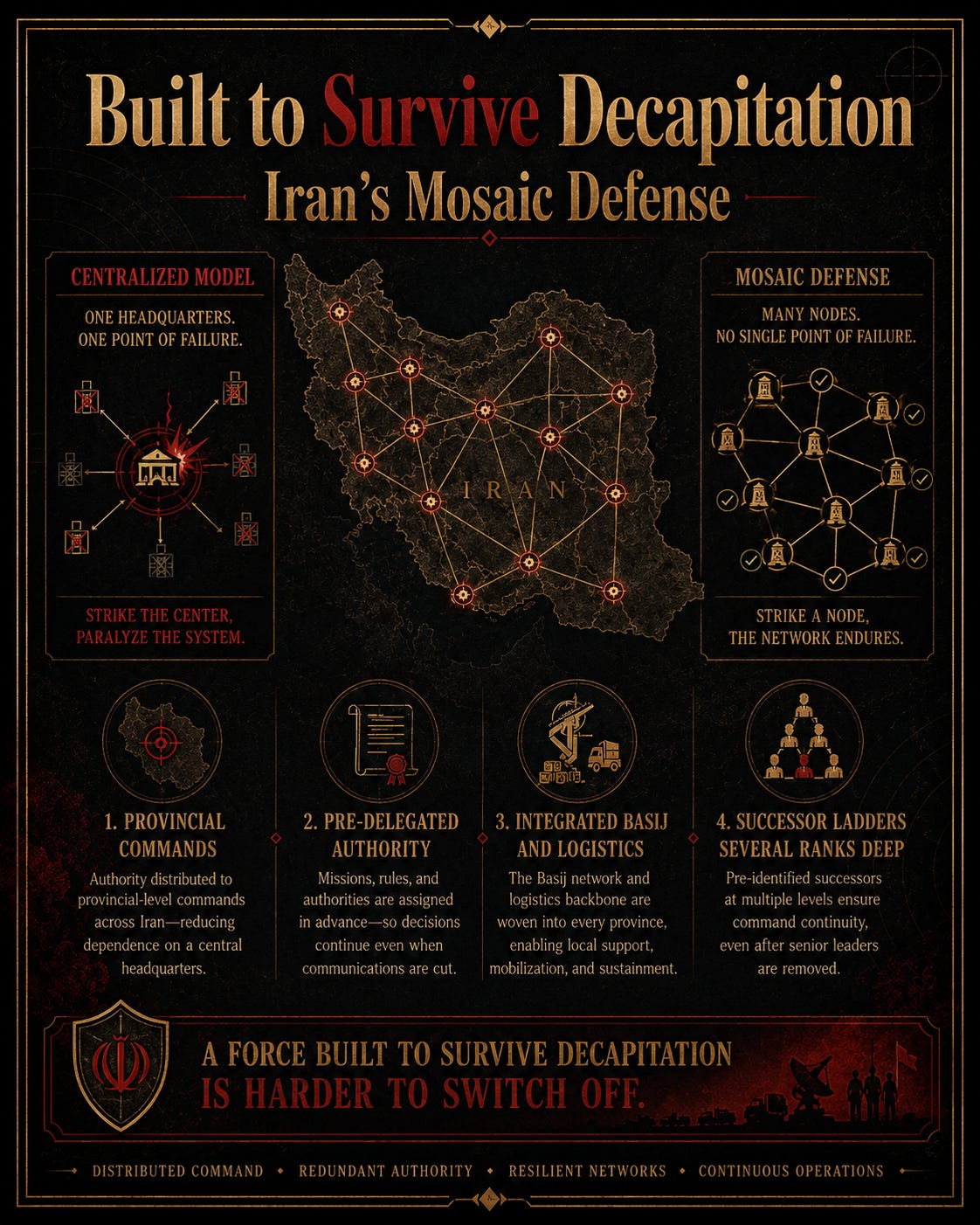
The response was a doctrine the Revolutionary Guard calls mosaic defence. Formalised from 2005 and built out by 2008 under General Mohammad Ali Jafari, it broke the Guard into roughly thirty-one provincial commands, each with its own weapons, intelligence, logistics and integrated Basij units, and each holding pre-delegated authority to act without instruction from the centre. The governing assumption was blunt: decapitation is not a decisive blow if the body keeps moving. Authority was pushed down through what Iranian officials describe as successor ladders, with named replacements several ranks deep for every senior post, ready to step up the moment a superior is killed.
The design held under the heaviest test it has faced. With the Supreme Leader and much of the high command gone, provincial units regrouped and fired on their own initiative, which accounts for a reply that arrived within hours rather than days. The same feature carries the danger the article has traced. A force built to keep fighting without its head is, by definition, a force that no head can easily call back. Decentralisation bought survivability at the cost of control. The patient centre that once bounded escalation has been removed, and the machine left in its place was engineered to continue regardless of who gives the order. Several analysts of the doctrine have made the warning explicit: the structure that prevents collapse also removes the off-switch.
Where the readings collide
The American decision applied one culture’s meaning to a situation governed by two others. Decapitation reads as victory inside a framework where the leader is the regime and the regime is the threat. It reads as martyrdom inside a framework built on the memory of Karbala. Preemption reads as prudence to a state with no depth to spare. It reads as humiliation to a state whose political identity is organised around resisting exactly that. The coalition acted on its own grammar and misread the other two, and the gap between intention and reception is where the crisis now lives.
The outcome remains open. The Iranian system may yet fracture under the strain, security forces may defect, and serious analysts disagree about the trajectory. The mechanism, though, is already visible, and it has little to do with the balance of weapons.
The Deepest Insight
Israel fears annihilation.
America fears the loss of its credibility.
Iran fears humiliation.
Each fear is rational within its own cultural framework.
When nations respond to different fears, they misread one another’s actions almost by default.
The most dangerous conflicts are not those in which one side misunderstands the other.
They are those in which every side believes it understands the other perfectly.
Further reading
On Israeli directness as a cultural form, Tamar Katriel’s *Talking Straight: Dugri Speech in Israeli Sabra Culture* (Cambridge University Press, 1986) remains the foundational study.
On the pre-Islamic roots of Iranian mourning and martyrdom, see Ehsan Yarshater’s essay on taʿziyeh and pre-Islamic mourning rites, summarised in the Encyclopaedia Iranica entry on [taʿzia](https://www.iranicaonline.org/articles/tazia/).
On humiliation as a driver of the current conflict, see the Foreign Policy Research Institute, [”Humiliation and Transformation: The Islamic Republic After the 12-Day War”](https://www.fpri.org/article/2025/10/humiliation-and-transformation-the-islamic-republic-after-the-12-day-war/).
On why the system did not collapse, see Al Jazeera, [”Why the Iranian regime did not collapse after Khamenei’s assassination”](https://www.aljazeera.com/opinions/2026/3/17/why-the-iranian-regime-did-not-collapse-after-khameneis-assassination), and the Brookings Institution, [”After the strike: The danger of war in Iran”](https://www.brookings.edu/articles/after-the-strike-the-danger-of-war-in-iran/).
On the mosaic defence doctrine and its consequences, see The Soufan Center, [”Iran’s ‘Mosaic Defense’ Strategy: Decentralization as Resilience Factor”](https://thesoufancenter.org/intelbrief-2026-march-9a/); the Jerusalem Institute for Strategy and Security, [”Iran’s Mosaic Defense Faces Its Real Test”](https://jiss.org.il/en/grinberg-irans-mosaic-defense-faces-its-real-test/); and Radio Free Europe/Radio Liberty, [”With Top Brass Dead, Iran Deploys Decentralized ‘Mosaic’ Strategy”](https://www.rferl.org/a/iran-irgc-israel-us-war/33697690.html).