

A negotiation in Pune
Sixth floor, monsoon outside. An Indian distributor along one side of the table, a Korean components manufacturer along the other, and between them the interpreter.
Volumes agreed, tooling agreed. Then the Indian managing director raised the discount on the second order, and the senior Korean executive said: “Gwaenchanayo”
‘That’s fine,’ the interpreter said.
Twenty minutes later the Indian side offered fifteen extra days on payment. The Korean executive used exactly the same expression. “Gwaenchanayo”
‘No, thank you.’
The managing director put down his pen. ‘Same word, twice. First a yes. Now a no. One of those is you.’
‘Neither, sir. Both are correct.’
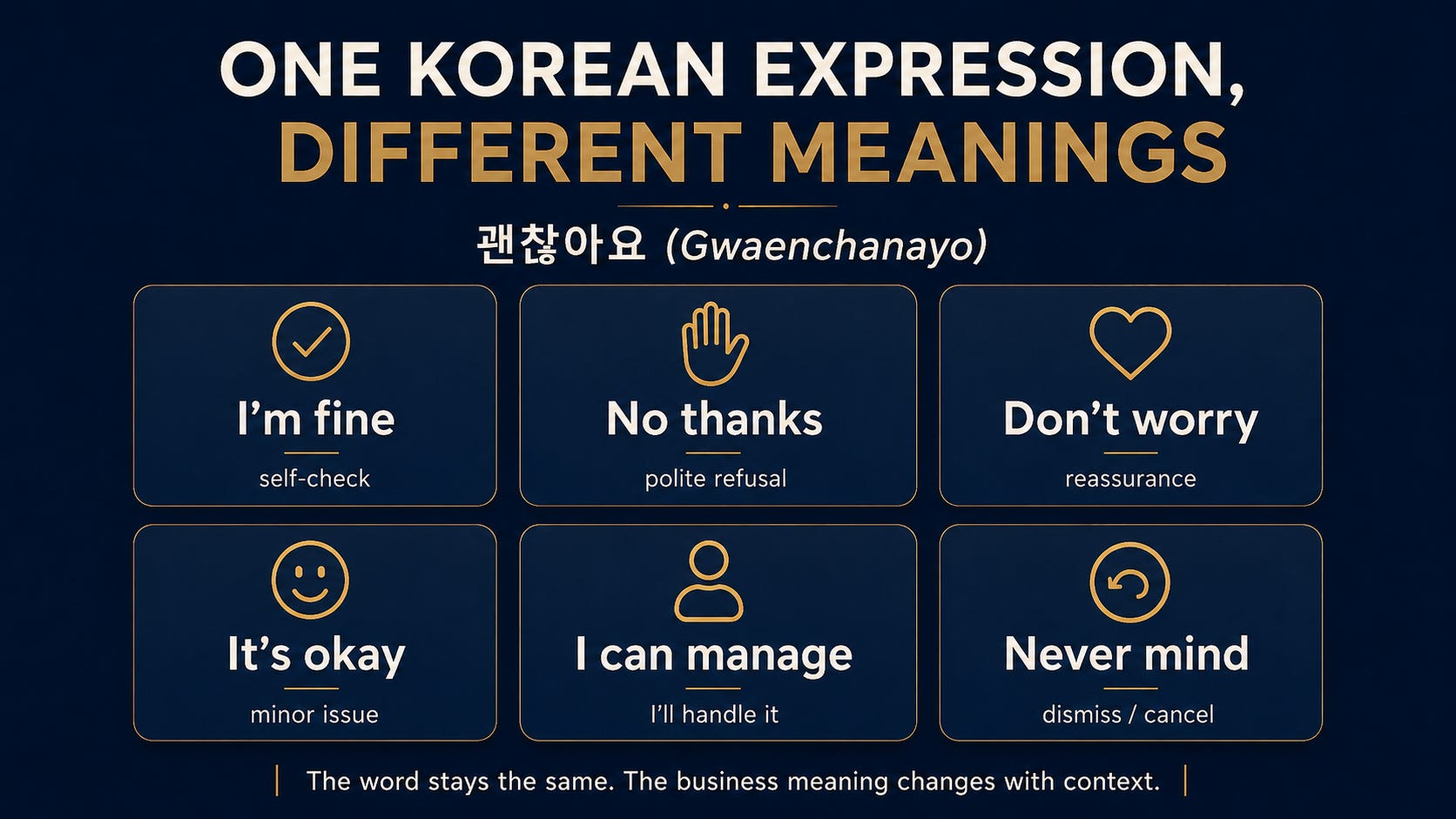
One expression, built around gwaenchanta, takes on at least six separate jobs, sorted entirely by the situation. Politeness level alters the ending without altering the range, so the identical expression arrives as (gwaenchanseumnida) in a formal negotiation and (gwaenchanayo) once the room warms up.
The explanation ran ninety seconds, in English, at speed. Across the table the Korean executive watched an animated conversation he had not been invited to, arising from a sentence he had never spoken.
‘Nothing was said. Both of you have been talking for two minutes. Explain, please.’
The interpreter explained, in Korean. The Korean executive found the idea interesting, and his questions took a while.
The managing director listened to two and a half minutes of Korean, none of it preceded by anybody saying anything, and set his pen down again. ‘He said nothing. You said a great deal. Same question as before.’
At which point the man in the middle understood that he was the only person in the room who knew what was happening, and that the position carried no authority whatsoever.
Korean is hardly alone.
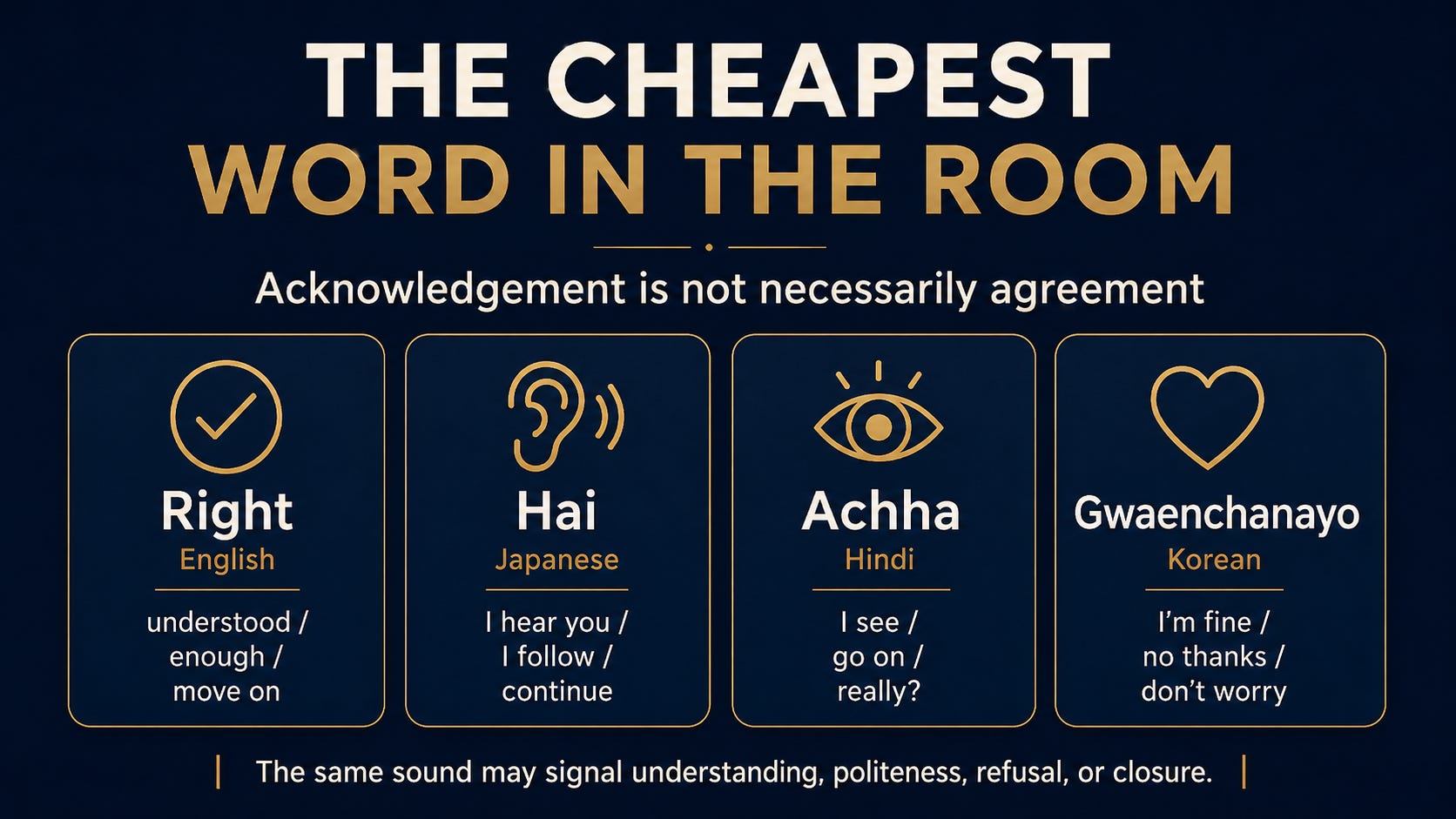
Acknowledgement is not agreement
One of the simplest rules in cross-border communication is also one of the most widely ignored. Somebody says okay, right, sure, fine, achha, hai or hǎo, and we hear a positive-sounding word and mentally tick the box.
Very often the speaker has said only: I heard you.
The gap between hearing and agreeing can be worth a great deal of money, and the loss arrives late. A misread token produces no argument in the room. Everybody leaves satisfied, the minutes record agreement, and the disagreement surfaces three weeks later, when a shipment fails to move or an invoice arrives against a discount nobody accepted. By then both sides have documentation supporting incompatible readings of the same afternoon.
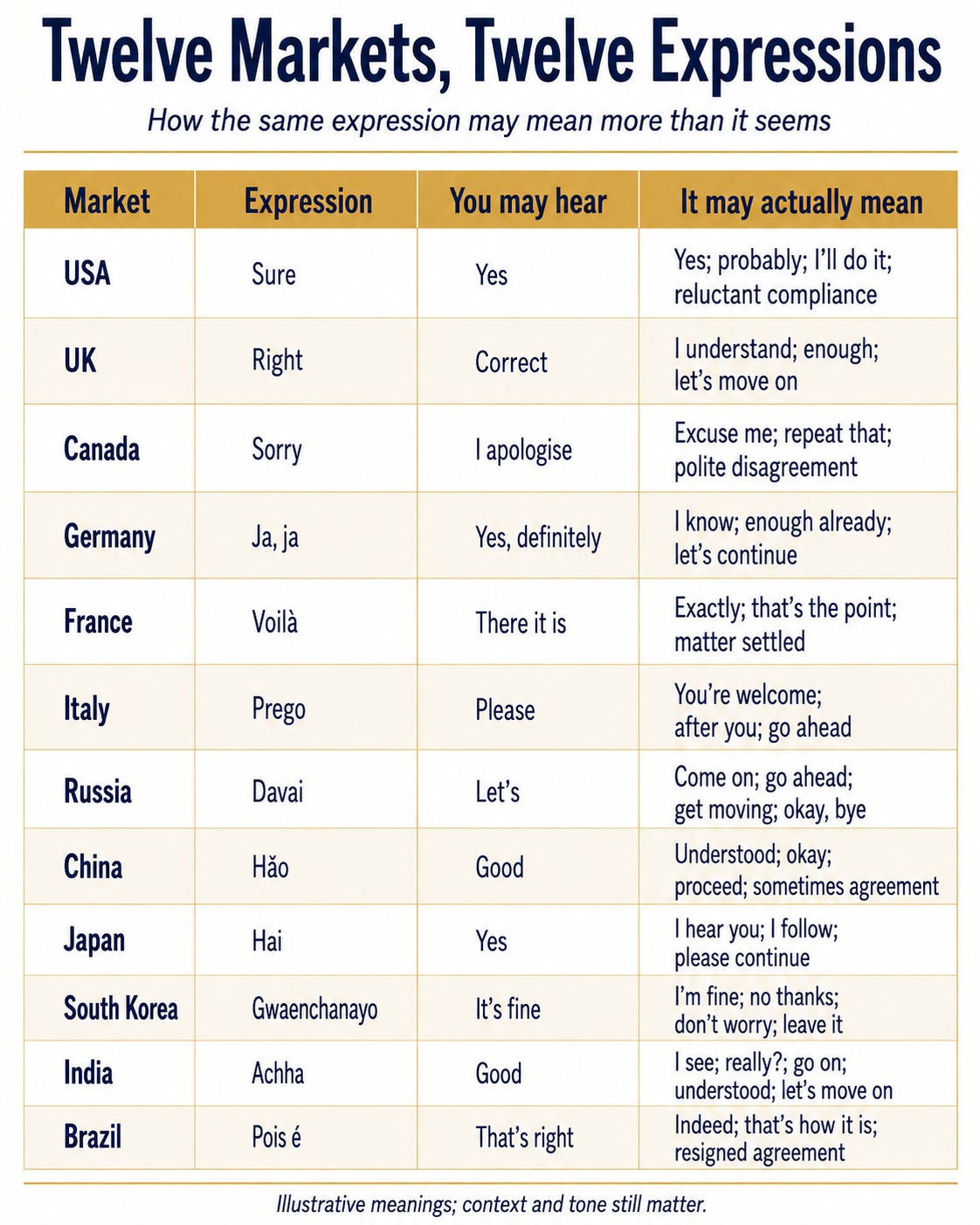
None of these readings is a rule. Tone matters, timing matters, and so do relationship, age, hierarchy, region and situation. The dependence on all six is exactly what makes the words dangerous.
Sorted by the job they mostly do, the twelve fall into three loose families.
Reception markers keep the channel open. Japanese hai, Indian achha and Mandarin hǎo often sit here, and the risk they carry is over-reading, since a foreign listener hears agreement in a slot where the speaker offered attention.
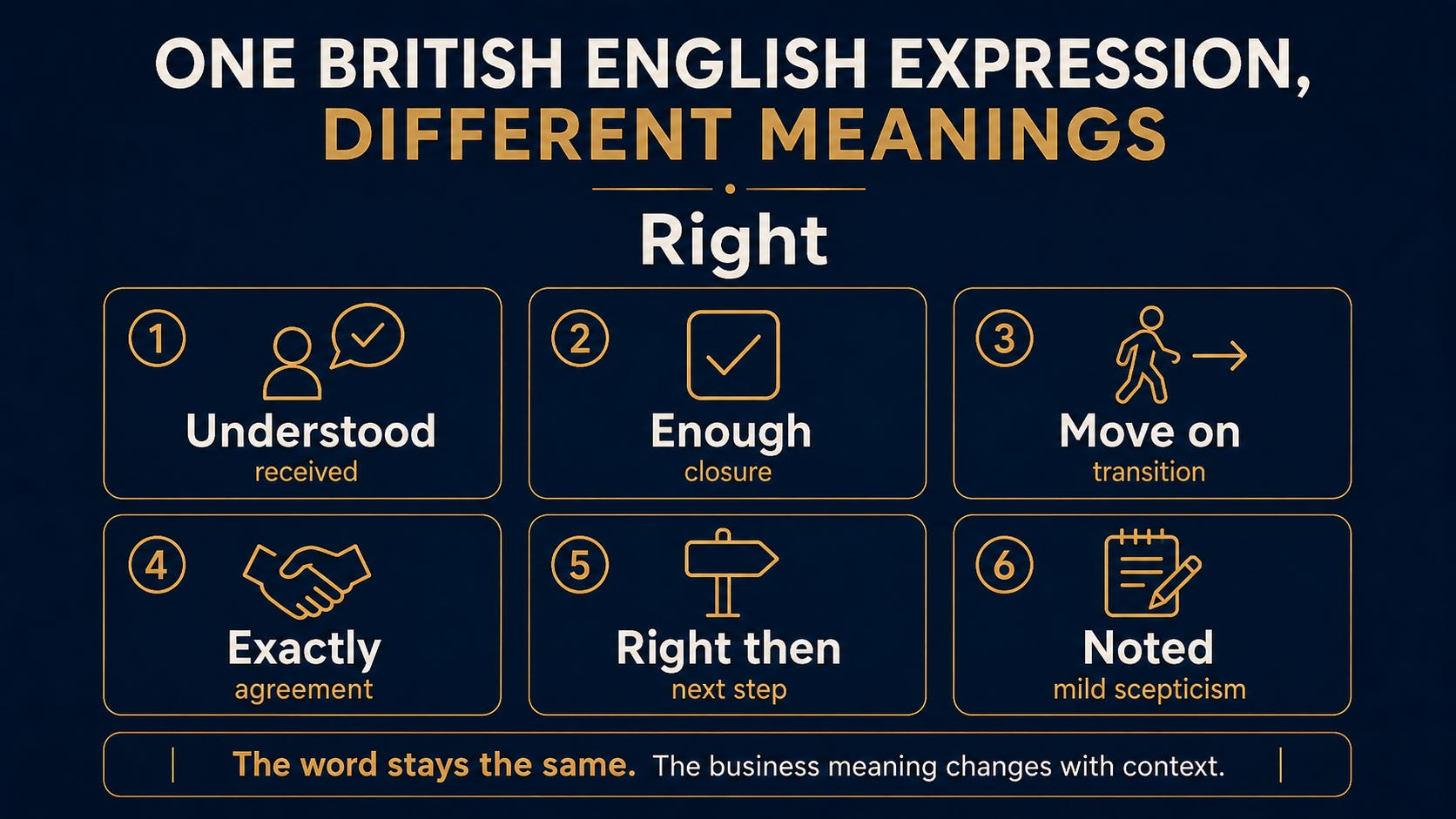
Transition markers close a topic and open the next. French voilà, Russian davai, British right and much American use of okay work this way, and the risk is under-reading, since a listener who takes the word as agreement keeps talking after the decision has been made.
Stance markers manage the relationship rather than the information. Korean gwaenchanayo, Canadian sorry, German doubled ja, ja and Brazilian pois é fall here, and they carry the widest range, from reassurance to refusal to mild irritation.
Boundaries between the three blur constantly. A single word crosses families depending on where it lands in the turn, which is the difficulty in miniature.
Three closer looks
The Japanese yes. A Japanese colleague says hai, and many English speakers hear yes. The word often sits much closer to: I am listening.
‘We can ship the equipment by the 15th.’ ‘Hai.’ ‘And commissioning can begin on the 18th.’ ‘Hai.’ ‘So we will mobilise your team immediately.’ Silence.
Nothing went wrong in the translation. The mistake happened one step earlier, when acknowledgement was converted into commitment. Anyone who has sat through a Japanese meeting will recognise a related rhythm, where hai arrives every few seconds throughout a presentation, in a pattern closer to a nod than to a signature.
The Indian achha. Anyone working in India discovers how much labour a single word performs. Six readings sit inside it, separated by delivery alone.
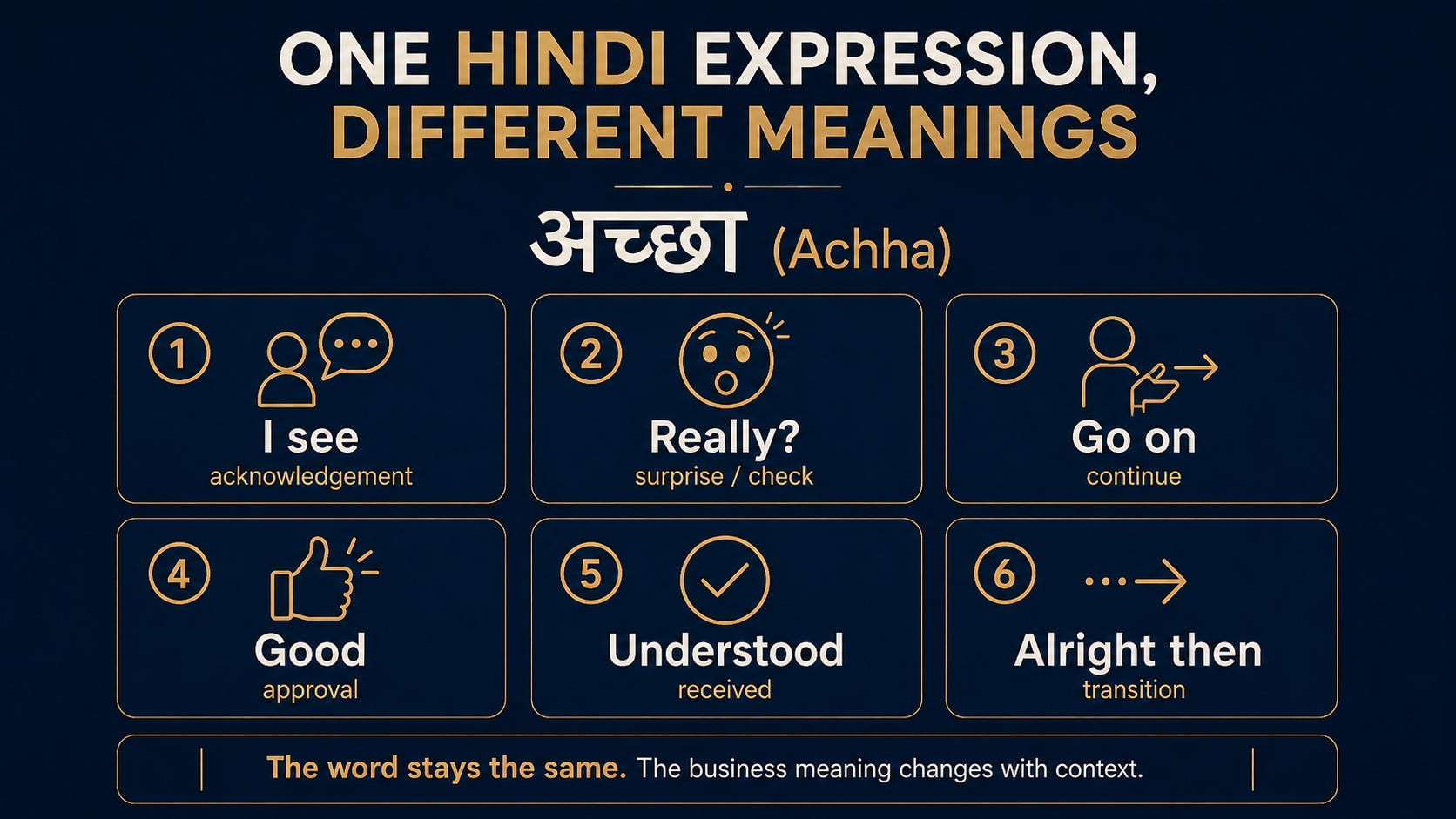
An Indian executive can use it forty times in a meeting without agreeing to a single proposal. Length carries much of the load: a clipped achha tends towards understood, while a stretched one leans towards surprise or doubt, and a doubled one often announces a change of subject. The same executive then switches to English and says ‘okay, okay’. The habit has crossed languages. The words are English, and the system underneath them remains Indian.
English speakers do it to each other. A British executive listens to a presentation and eventually says ‘right’, and the presenter hears correct, please continue. The executive may mean: I have understood enough, we should move on.
An American says ‘sure’, which might carry absolutely, or fine if that’s what you want, or I don’t love this and I won’t fight about it. The dictionary offers no help. The rest of the conversation does.
The smallest words carry the biggest context
English okay makes the point without leaving the language.
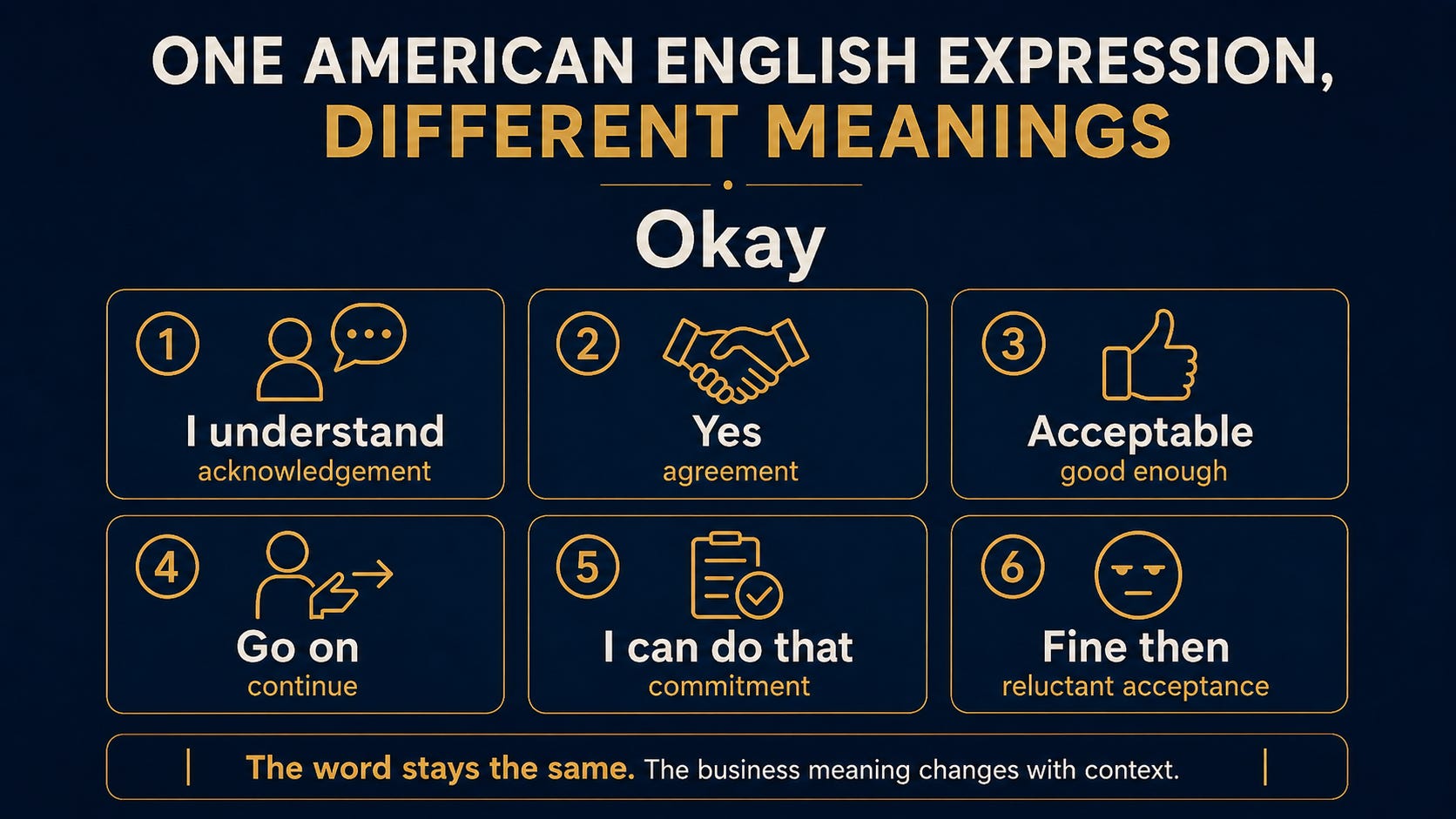
‘Are you okay?’ ‘Okay.’ ‘Can you do this?’ ‘Okay.’ ‘The shipment is delayed.’ ‘Okay…’ ‘Okay, let’s move on.’ ‘Okay?!’ One word, six messages, no confusion among people who share the system.
Linguists call these expressions response tokens or discourse markers. Their job is to manage the conversation rather than add information, and their meaning comes from position, tone, repetition and what happens next as much as from the word itself. Patricia Clancy and colleagues showed the pattern by comparing English, Japanese and Mandarin. All three languages solve the same problem, which is showing that the listener is still engaged, and none of them solves it the same way.
Four separate forces push languages towards overloading their cheapest words.
Efficiency. Piantadosi, Tily and Gibson argued that ambiguity is a feature of efficient communication rather than a defect in it, since context already does part of the work. A high-frequency expression needs no separate form for every possible meaning if the situation normally reveals which meaning applies. Zipf made a version of the argument decades earlier, framing it as a bargain between a speaker who wants low effort and a listener who wants easy interpretation. Acknowledgement words are the most frequent, lowest-effort items anybody produces in a working day, which puts them first in the queue for reuse.
Position. A recent volume comparing okay across thirteen languages, including Brazilian Portuguese, French, German, Italian, Japanese, Korean and Mandarin, reached a conclusion with direct operational value: the tone of the token and its placement in the sequence are what create the distinct uses. The word is a slot filler. Meaning arrives from where it sits and how it lands, and both travel badly down a poor connection.
Face. Declining is the costly act in every culture yet studied, and cultures with strong face economies route refusal through a word with positive value. Korean gwaenchanayo, Japanese daijōbu, Brazilian tá bom and British right all perform refusal while sounding agreeable, which leaves both parties a way out. Research on Japanese refusals found three recurring features: avoiding an explicit no, attributing the reason to a third party, and offering a reason that both sides understand to be a formality.
History. Each token descends from a content word that lost its weight. Mandarin dui began as a verb before settling into its role as a particle. Hindi achha traces back to a Sanskrit sense of clear or transparent. Korean gwaenchanta remains a live adjective alongside its use as a token. Ordinary language change, running everywhere, in every period.
The four stack neatly. Efficiency explains the reuse, position explains the range, face explains which meanings cluster together, and history explains where the word came from.
A fifth observation sits underneath all of them. Mark Dingemanse and colleagues, comparing how speakers of unrelated languages signal that they have missed something, found the same short questioning syllable turning up across language families, and concluded that it arrives by convergent evolution rather than shared ancestry. Conversation sets identical engineering problems everywhere. Unrelated languages keep inventing the same small tool.
Inside one linguistic community the whole system stays invisible, because everybody shares the decoding key. Trouble begins when the word crosses a border and the key stays behind.
The token survives the switch to English
The commercial risk concentrates at one point, and it is not the point most people watch.
Interpreted meetings are comparatively safe, since a professional interpreter reads the token in context and delivers the meaning rather than the word. Meetings held in English between non-native speakers are where the losses gather. Speakers carry the habits of the first language into the second, so the token looks English and behaves locally.
An Indian manager on a call says ‘okay, okay’ in the slot where achha would go, marking reception. A German counterpart hears doubled agreement, which in German would be closer to impatience. A Korean colleague writes ‘it’s fine’ in an email, meaning the difficulty stays on the Korean side and needs no discussion. An American reads spare capacity and adds scope. Nobody has mistranslated anything. The words are correct, and the traffic underneath them runs on different rails.
Video calls sharpen the problem. Tone and timing carry a large share of the meaning, and both are the first casualties of compression, latency and a muted room. A half-second delay flattens the pause that would have signalled reluctance. Gallery view removes the glance between two colleagues that would have told you everything.
Five things worth listening for
Before treating a positive-sounding word as agreement, five quick checks are usually enough.
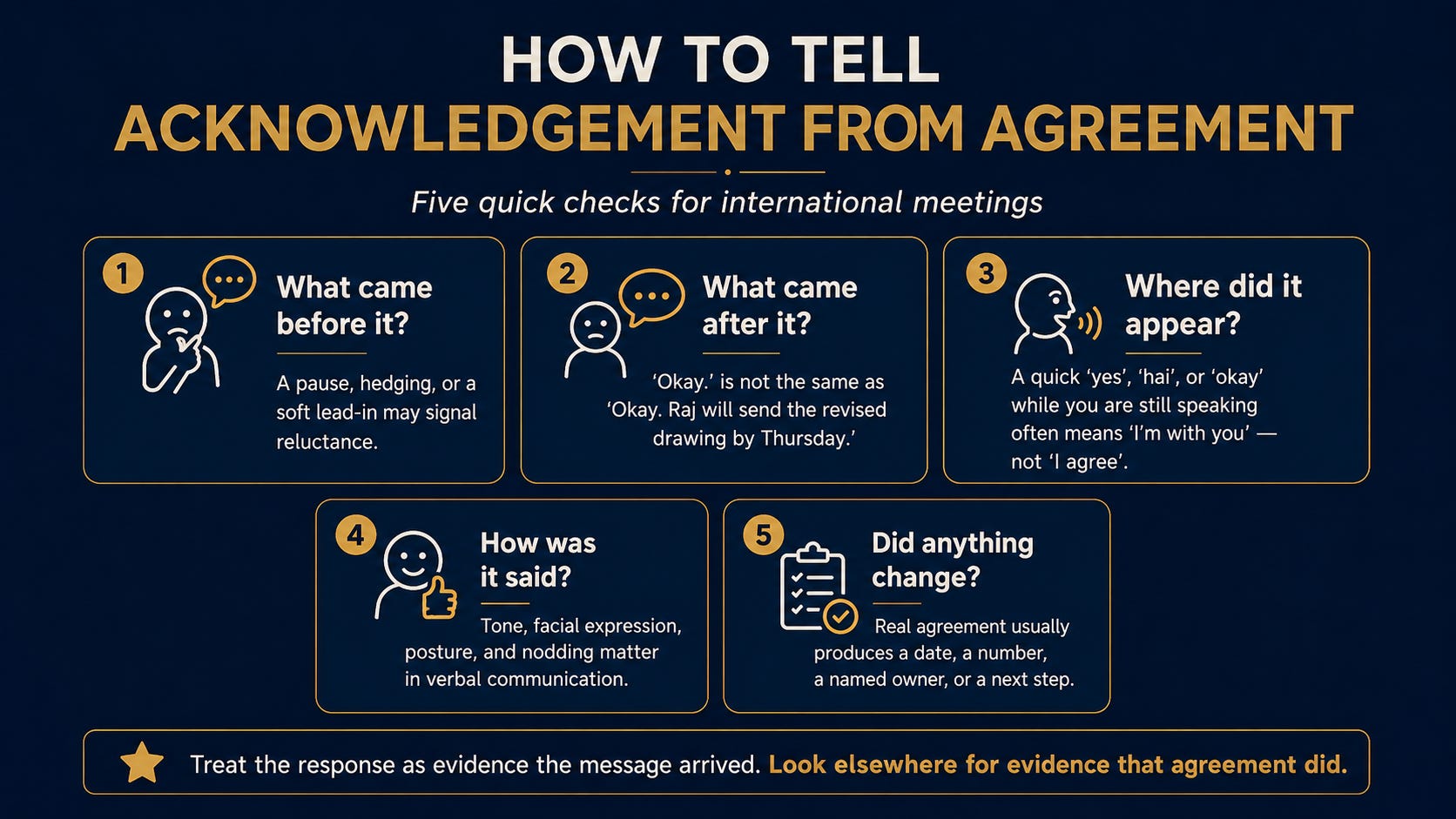
1. Notice the lead-in. A pause, a hedge or a soft preface ahead of the word often signals reluctance that the word itself conceals. ‘Well…okay’ and ‘okay’ are different answers.
2. Look at what followed. Compare ‘okay’ with ‘okay, Raj will send the revised drawing by Thursday’. Names, dates, quantities and actions turn acknowledgement into something closer to commitment.
3. Note where it appeared. A word such as yes, hai, right or okay offered while you are still speaking is usually keeping the conversation moving. It means: I am still with you. Agreement needs better evidence, and agreement rarely arrives in triplicate.
4. Register the delivery. Tone, facial expression, posture and the rhythm of nodding carry a large share of the meaning. Where the channel strips those signals, lower your confidence accordingly rather than assuming the words alone will do.
5. Check whether anything changed. After apparent agreement, look for movement. A date accepted, a price confirmed, an owner named, a next action defined. Where nothing changed, acknowledgement is the likelier reading.
The safest sentence in the room
Written confirmation after an important cross-border conversation settles what the five checks leave open, and the wording repays some care.
‘As agreed…’ quietly assumes the agreement already happened, and a counterpart who reads it as a claim rather than a question will often let it stand rather than open a dispute. Something closer to this works better:
‘My understanding is that we will ship 500 units by 15 October, with commissioning beginning on 18 October. Please correct anything I have captured differently from your understanding.’
It names the commitment, makes disagreement easy, and lets the other side correct the record without losing face. Sending it within the hour matters more than polishing it, since memory of the room fades quickly on both sides. A small difference in wording prevents a very large argument later.
Back in Pune
The managing director spends the afternoon questioning how one Korean expression can carry so many meanings. Then, after a further explanation from the interpreter, he responds: ‘Achha.’
The interpreter pauses. ‘Sir, which achha?’
The room laughs, because everyone suddenly sees the shape of the problem. Ambiguity is far easier to spot in somebody else’s language than in your own. Our own right, sure, okay, achha, hai and gwaenchanayo feel perfectly obvious to us, which may be the most dangerous assumption anyone brings into an international meeting.
The email went out at 4.40, nine lines, all of them numbers. Six were right. Both sides found the other three the next morning, roughly three days earlier than usual, and considerably cheaper.
Where the research thins out
Honesty about the evidence belongs in a piece like this.
The general framework rests on solid ground. Response tokens have been studied for forty years, the comparative work across English, Japanese and Mandarin is careful, and the efficiency argument has been tested well beyond conversation.
Coverage of individual words runs unevenly. English okay has an entire academic volume to itself. Mandarin hǎo and duihave been mapped in detail. Russian and its neighbours are served by a volume tracing a whole family of related particles across Europe. Hindi achha and Korean gwaenchanayo, by contrast, have attracted remarkably little dedicated peer-reviewed attention, given that hundreds of millions of people use them daily and a good deal of commerce passes through them. Most of the available description sits in teaching materials rather than journals.
Anyone reading the table above should treat it as a working guide assembled from research where research exists and from practitioner observation where it does not.
Two notes
On the gap. When Culture Collides with Language, the book behind this article, runs to twelve country chapters, and none of them covers the country’s acknowledgement words. Other linguistic features are missing as well, and a future edition will need to carry them. Additions from native speakers are welcome, since range shifts with region, generation and industry.
On the sources. The reading list below covers the linguistics. Requests for papers on a specific language are welcome, and several of the works carry chapter-length treatments of individual markets.