

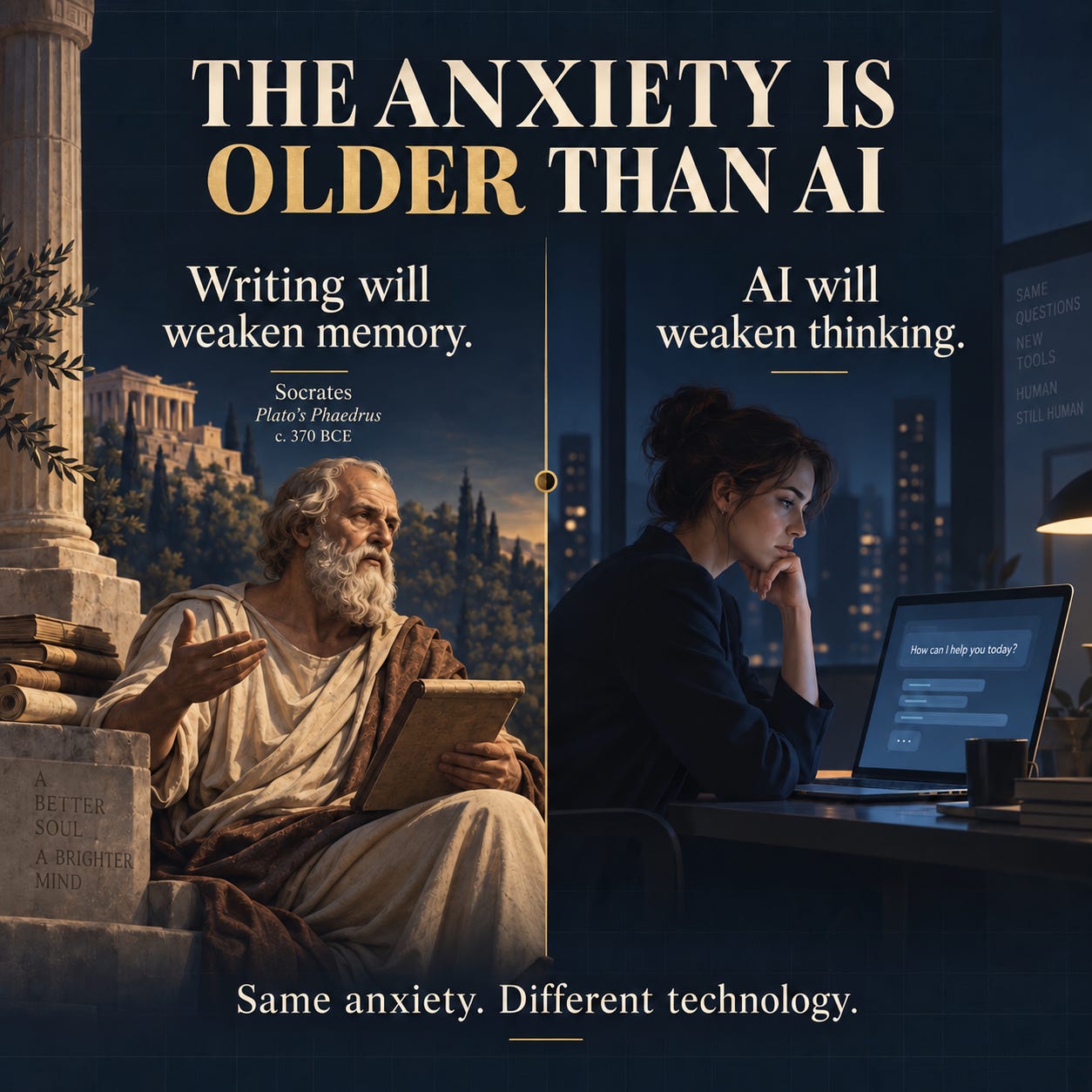
Socrates distrusted writing
In Plato’s Phaedrus, he recounts the argument that written marks would weaken memory, encouraging people to rely on external records rather than exercise their minds. Readers might acquire the appearance of wisdom without the substance of understanding.
Two and a half millennia later, the technology has changed. The anxiety sounds familiar.
AI will weaken thinking. Students will stop learning. Professionals will lose judgement. Writers will forget how to write. Knowledge will grow shallow because machines can produce answers faster than humans can construct them.
Some of those concerns may prove justified.
Humans have been having versions of this argument for a very long time.
Agriculture may have looked like a terrible idea
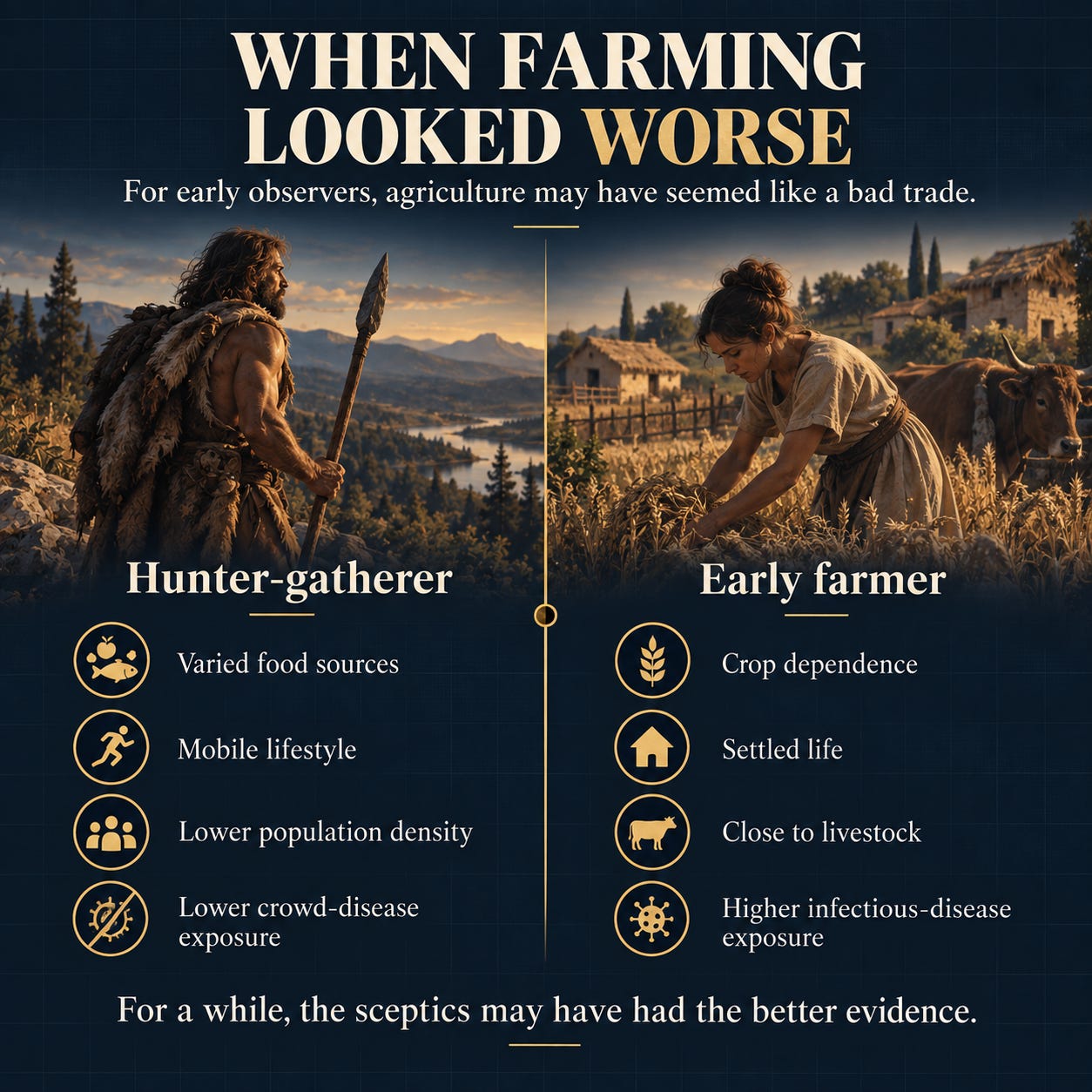
Imagine an early farming settlement seen through the eyes of a hunter-gatherer.
The farmers stay in one place. They live in larger communities, often beside domesticated animals, and depend heavily on a narrow range of crops. Infectious disease spreads more easily. A failed harvest threatens everyone at once.
Archaeological evidence suggests that the transition to agriculture coincided, in many populations, with poorer health indicators. Average stature declined in some regions. Dental problems increased. Signs of nutritional stress became more common.
A hunter-gatherer looking across at these communities might reasonably have concluded that the farmers had made their lives worse.
For a long stretch of time, the evidence may even have supported that judgement.
Agriculture transformed humanity for reasons largely invisible at the beginning. Settled food production eventually supported larger populations, specialisation, cities, organised states, written administration, universities and technologies that the first farmers could hardly have imagined.
The costs were real.
The possibilities sat outside the frame of anyone living inside the transition.
That distinction matters.
New systems get measured by old standards
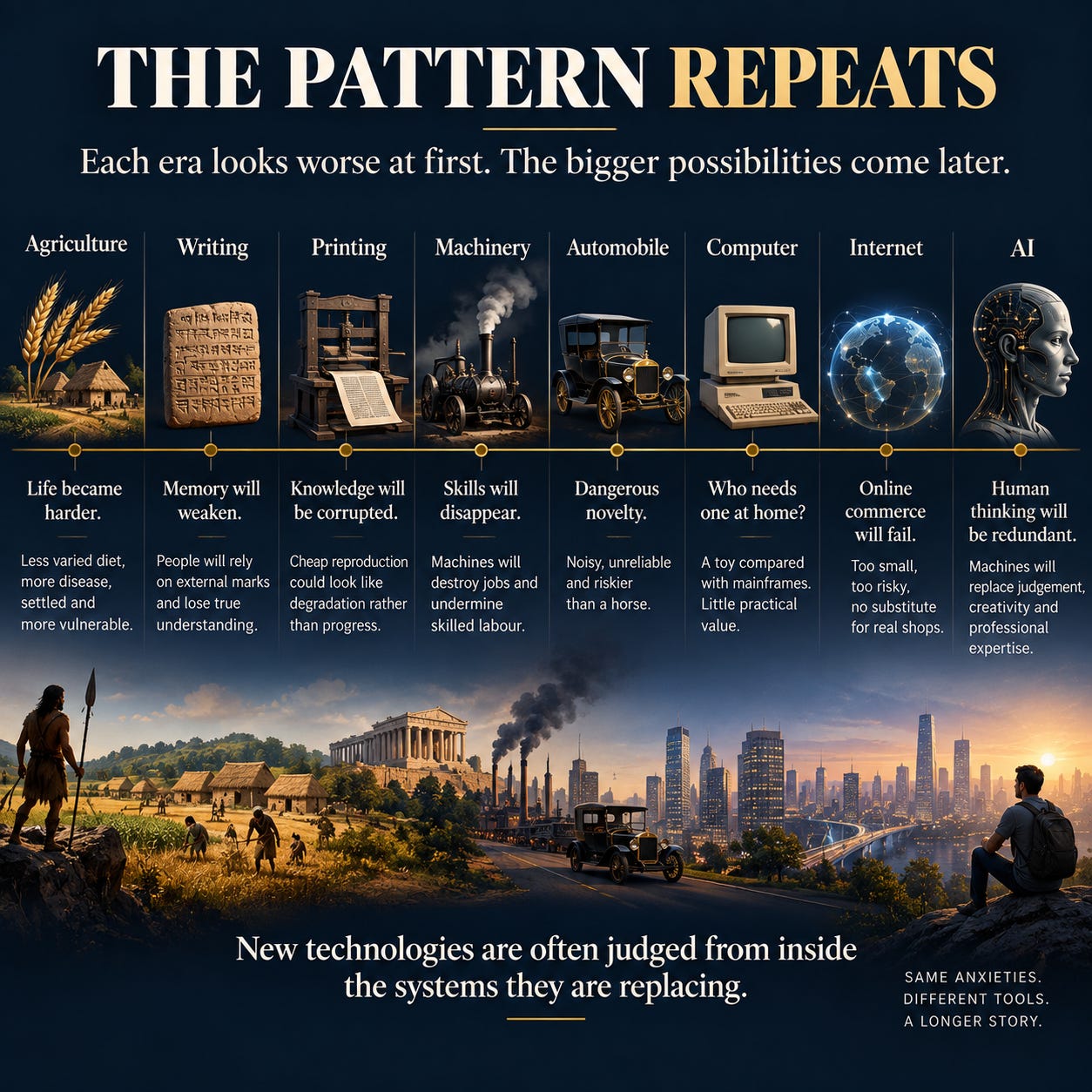
A disruptive technology usually arrives looking inferior on at least some dimension the established system values.
Writing can weaken memorisation because information no longer has to reside entirely inside the human mind.
Printing made copying less exclusive. To scribes trained in manuscript culture, cheap reproduction could look like degradation rather than democratisation.
Early automobiles were noisy, unreliable and dangerous beside a good horse. They broke down on poor roads with little fuel infrastructure.
Personal computers looked trivial beside mainframes. Online shopping looked laughably small beside established retail. Early digital photography offered poorer image quality than film.
Judging an emerging technology by those measures can be perfectly rational at the time.
The error comes when present limitations are projected indefinitely into the future.
Technologies improve. Infrastructure grows around them. Social norms shift. Occupations emerge. Regulation follows. Complementary tools appear.
Eventually the original comparison stops making sense.
Smartphones are rarely assessed as telephones any more because the category itself changed.
Resistance carries information
Technological history is often told as a procession of foolish sceptics.
It is comforting. It is also misleading.
The Luddites illustrate the problem. They are remembered as workers who hated machinery for its own sake. Their objection was considerably more substantial.
Machines were altering wages, working conditions, bargaining power and the value of skilled labour.
The machines worked
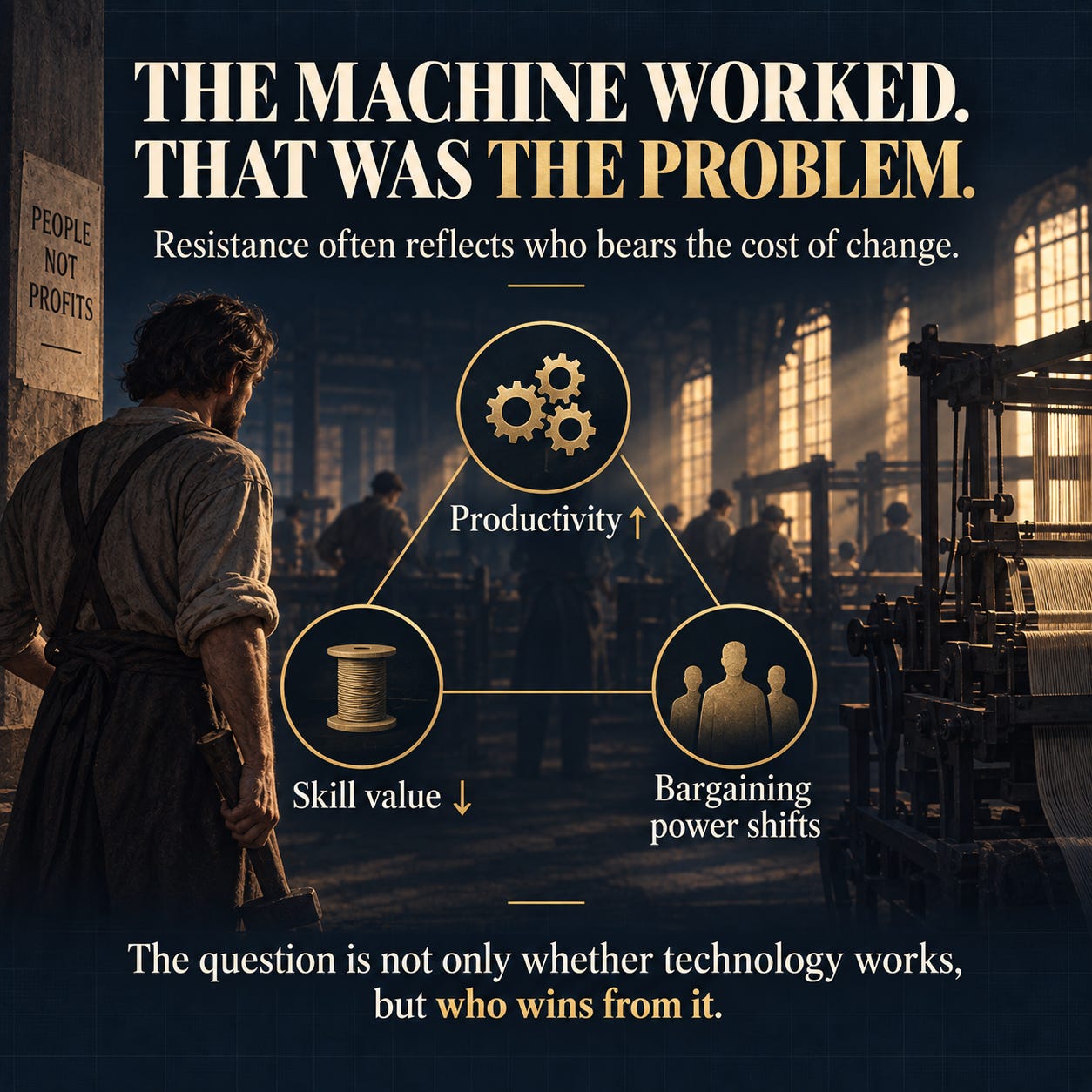
That was precisely the problem.
Technological change distributes benefits unevenly. A machine can raise total productivity while destroying the livelihood of the person whose skill it replaces. Society can become richer while particular communities absorb most of the transition cost.
Both things can be true.
Recorded music threatened musicians who lived on live performance. Photography challenged established assumptions about artistic skill. Mechanisation displaced crafts. Spreadsheets removed enormous quantities of manual calculation. ATMs automated one of the central functions of bank tellers.
Many of those professions survived, but their boundaries changed.
New tasks became valuable once machines handled the old ones more cheaply.
Resistance often identifies something real. The useful test is whether it points to a permanent limitation of the technology or a genuine cost of transition.
Those are very different claims.
The skill the machine performs
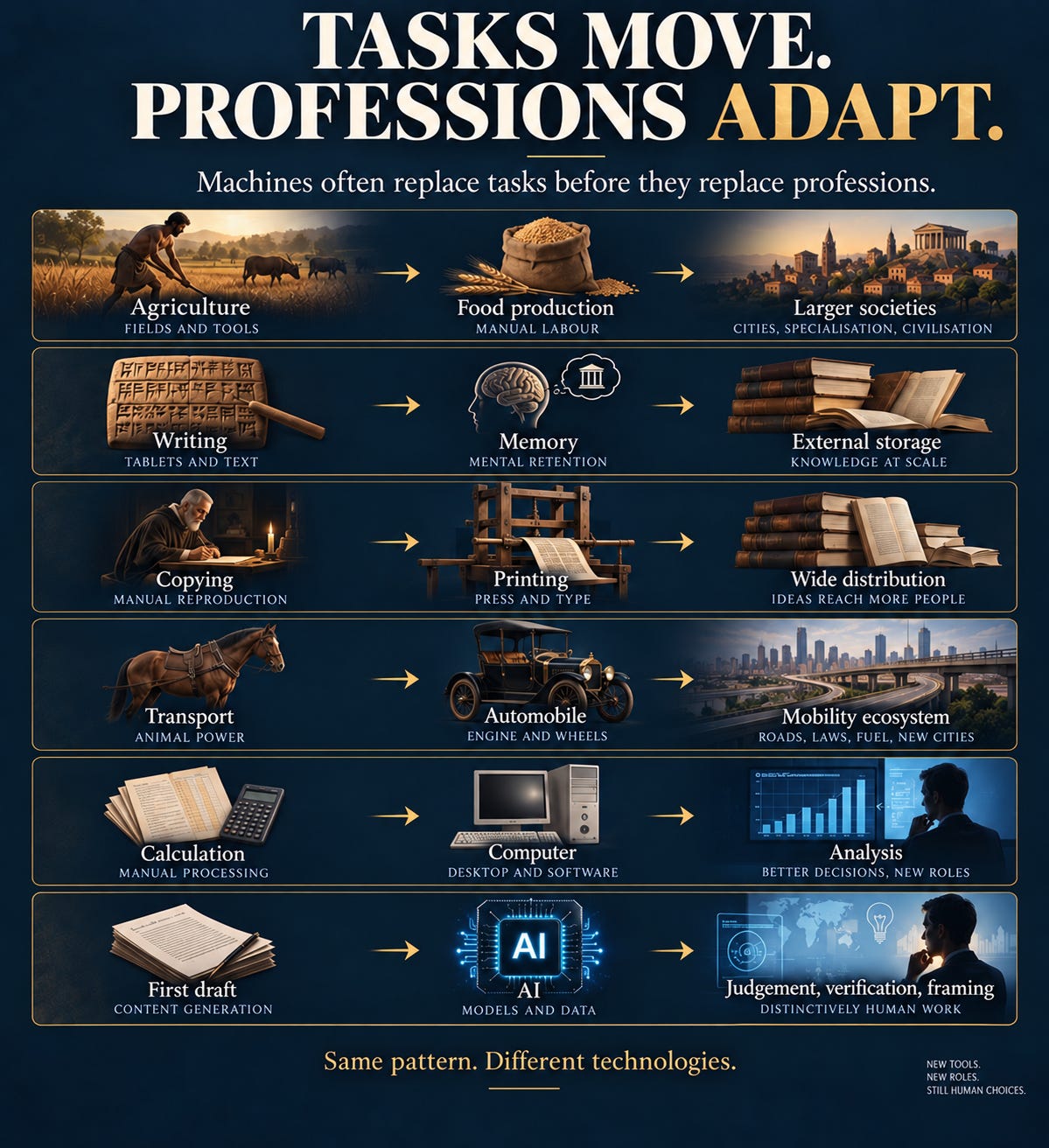
Calculators produced another familiar argument.
Children who could press buttons for arithmetic might never learn mathematics.
The outcome landed somewhere between prohibition and surrender.
Students still learn arithmetic. Calculators absorb work that would otherwise consume time. Education gradually shifted towards deciding which cognitive skills humans still need to master directly.
Spelling checkers, search engines, navigation systems and spreadsheets followed similar paths.
Few analysts now build complicated financial models by hand merely to prove that they can. A financial analyst still needs enough mathematical understanding to recognise when the spreadsheet is producing nonsense.
GPS reduced the need to memorise routes. It also left many people less capable of navigating without it.
Technology grants capability while sometimes eroding the underlying human skill.
Socrates had a point.
The sharper question is which skills remain valuable enough to preserve deliberately.
AI brings that question to the centre of intellectual work.
Cognition changes the stakes
Earlier machines primarily replaced physical labour, calculation, storage or transmission.
Generative AI drafts, summarises, analyses, translates, codes, illustrates and increasingly reasons across information.
The perceived threat therefore feels more personal.
A machine replacing muscle raises economic questions.
A machine appearing to replace parts of thinking raises questions about human value.
Writers ask whether writing matters when paragraphs appear instantly. Programmers wonder which parts of coding remain distinctively human. Teachers worry about learning stripped of intellectual struggle. Designers face systems capable of producing hundreds of visual alternatives in minutes.
Some jobs will change substantially. Some tasks will disappear. New roles will emerge. Certain skills will lose economic value.
History offers no comfortable guarantee that everyone displaced by technological change eventually benefits from it.
It offers a different lesson.
The first-order effect of a new technology rarely reveals its final social form.
Societies build around technologies
Cars replaced horses and then went much further.
Cities were rebuilt around them. Roads expanded. Petrol stations appeared. Traffic laws developed. Insurance spread. Suburbs grew. Restaurants, tourism and retail reorganised themselves.
The internet replaced letters and then reshaped commerce, publishing, dating, advertising, banking, entertainment, politics and the organisation of work.
Printing made books cheaper and then altered who could distribute ideas, who could challenge authority, and the scale at which scientific knowledge could accumulate.
Agriculture did far more than produce food differently.
Transformative technologies generate ecosystems.
AI has begun doing the same.
Organisations are redesigning workflows rather than merely adding a chatbot. Software increasingly carries intelligence inside ordinary processes. Jobs are being broken into tasks so that some can be automated while others remain human. Education is being forced to reconsider which abilities are worth testing once producing an answer becomes cheap.
Much of the eventual AI economy may consist of practices that are difficult to imagine while attention remains fixed on whether a chatbot can write a competent email.
A new mathematical toolkit
OpenAI announced in September 2026 that an internal system had produced a proof that three-dimensional fluid flow under the Navier-Stokes equations can develop a singularity in finite time, settling one of the Millennium Prize problems. Mathematics suits machines unusually well, since formalisation allows a computer to check a proposed proof line by line, separating what merely appears true from what is true.
A recent discussion on The World, the Universe and Us and New Scientist (What Does It Mean Now AI Has Solved Navier-Stokes?) offered a sharper way to think about the transition. The link to PodcastThe limitation sits in the why.
Algebra met geometry and caused a commotion
Descartes showed that the two fit together, so that equations could describe geometric shapes exactly. Some mathematicians feared their craft would shift from the beautiful geometric forms inherited from the Greeks to the pushing of symbols across paper, leaving them drone-like drudges with no real understanding. Modern physics followed instead, and every branch of mathematics developed across the next three centuries has drawn on those relationships in some form.
A decade of work, then thirteen minutes
Mathematicians spent more than ten years constructing five fair go-first dice, built so that several players could each roll once with no tie and a clear winner. A science journalist asked ChatGPT for a six-dice version and had a working set thirteen minutes later, produced on the free tier and existing nowhere on the internet. The researchers confirmed it worked, elegance aside.
The prompting was encouragement rather than technique
Plain English throughout, with nothing specialised about it. The model stalled, suggested dice of differing sizes, was told to carry on, and came back with an answer.
Formulating the problem, defining success and explaining why a result matters stay with the human. Once exploration becomes cheap, value moves towards deciding which answers deserve to be found.
The same technology enters different cultural systems
Technological history is often written as a single timeline.
Adoption rarely behaves that way.
The questions a society asks about a new technology are shaped partly by what it already values, trusts and fears.
Printing spread rapidly across much of Europe, while Arabic-script printing developed far more slowly in the Ottoman Empire. The reasons were mixed: political authority, religious institutions, established manuscript and calligraphic traditions, economic interests and the technical difficulty of reproducing Arabic script all played a part.
The machinery existed.
The surrounding system made adoption follow a different path.
More recent examples show the same pattern.
Mobile money moved through Kenya faster than through many wealthier economies because the gap it filled was larger. Cash retained its position in Germany and Japan long after adoption curves elsewhere suggested it would fade. Privacy expectations, institutional trust and established habits mattered alongside technology.
QR-code payments became ordinary in Chinese cities while shoppers in parts of Europe were still getting used to contactless cards.
Capability may be global.
Acceptance is local.
Organisations are discovering something similar with AI.
Give every office the same model, licence and training deck, and adoption can still diverge sharply.
In some teams, experimentation begins before policy arrives. Elsewhere, written permission provides the confidence to begin.
In some workplaces, a junior analyst can challenge an AI-generated answer attached to a senior colleague’s name without much hesitation. In others, hierarchy makes that socially harder.
Some professional cultures treat machine assistance as another tool in the workflow. Others attach authorship closely to individual competence, making disclosure more sensitive.
None of those responses says much about the underlying capability of AI.
They say a great deal about the environment into which that capability arrives.
Language adds another layer. Model performance varies across languages, especially where training data is thinner. A team working primarily in Bengali, Vietnamese or Swahili may judge the same tool very differently from a team working in English.
Both assessments can be accurate within their own conditions.
National culture is only one influence. Profession, organisation, generation, region and individual preference can matter as much or more. A software team in Bengaluru may resemble one in Berlin more closely than a government department in the same city.
The broader principle survives the caveat.
Technology supplies capability.
Culture influences which uses feel natural, legitimate or threatening.
Both sides usually hold part of the truth
Technological optimism can be as simplistic as technological pessimism.
Agriculture brought disease alongside abundance.
Printing spread propaganda alongside knowledge.
Industrialisation generated exploitation alongside extraordinary productivity.
Cars created mobility alongside congestion, pollution and road deaths.
The internet connected billions of people while creating new forms of fraud, surveillance, misinformation and dependency.
The survival of a technology proves little about whether its critics were wrong.
Societies often advance by discovering that both sides held part of the truth.
The technology creates value.
The critics identify costs.
Institutions slowly learn to manage both.
Laws change. Professional standards develop. Education adapts. Social expectations shift. Some behaviours become unacceptable. Others become ordinary.
Eventually the technology becomes embedded so deeply that the original debate begins to look strange.
AI may be different. The reaction is familiar.
Artificial intelligence may prove unusually consequential because of its speed, reach and capacity to replicate cognitive tasks.
It deserves scrutiny.
Questions about employment, intellectual dependence, concentration of power, misinformation, copyright, privacy and autonomous systems are exactly the questions societies should ask while a technology is still taking shape.
Catastrophic risk belongs in that discussion. A low-probability event with irreversible consequences still deserves serious preparation. The lesson from pandemics is not that every warning will prove correct. It is that waiting for certainty can leave institutions unprepared.
Speculative danger can also consume attention that present harms require. Bias, misinformation, energy and water use, copyright disputes and concentrated corporate power are visible now. The podcast used the term criti-hype: magnifying a technology’s most dramatic possibilities while appearing to criticise them. A warning can unintentionally reinforce the claim that the technology is almost limitless.
The sensible position holds both time horizons together. Examine catastrophic risk without allowing it to displace measurable harm. Study present harm without assuming that current capabilities define the upper limit.
History does caution against one prediction in particular:
The world visible during disruption is not necessarily the world that will remain
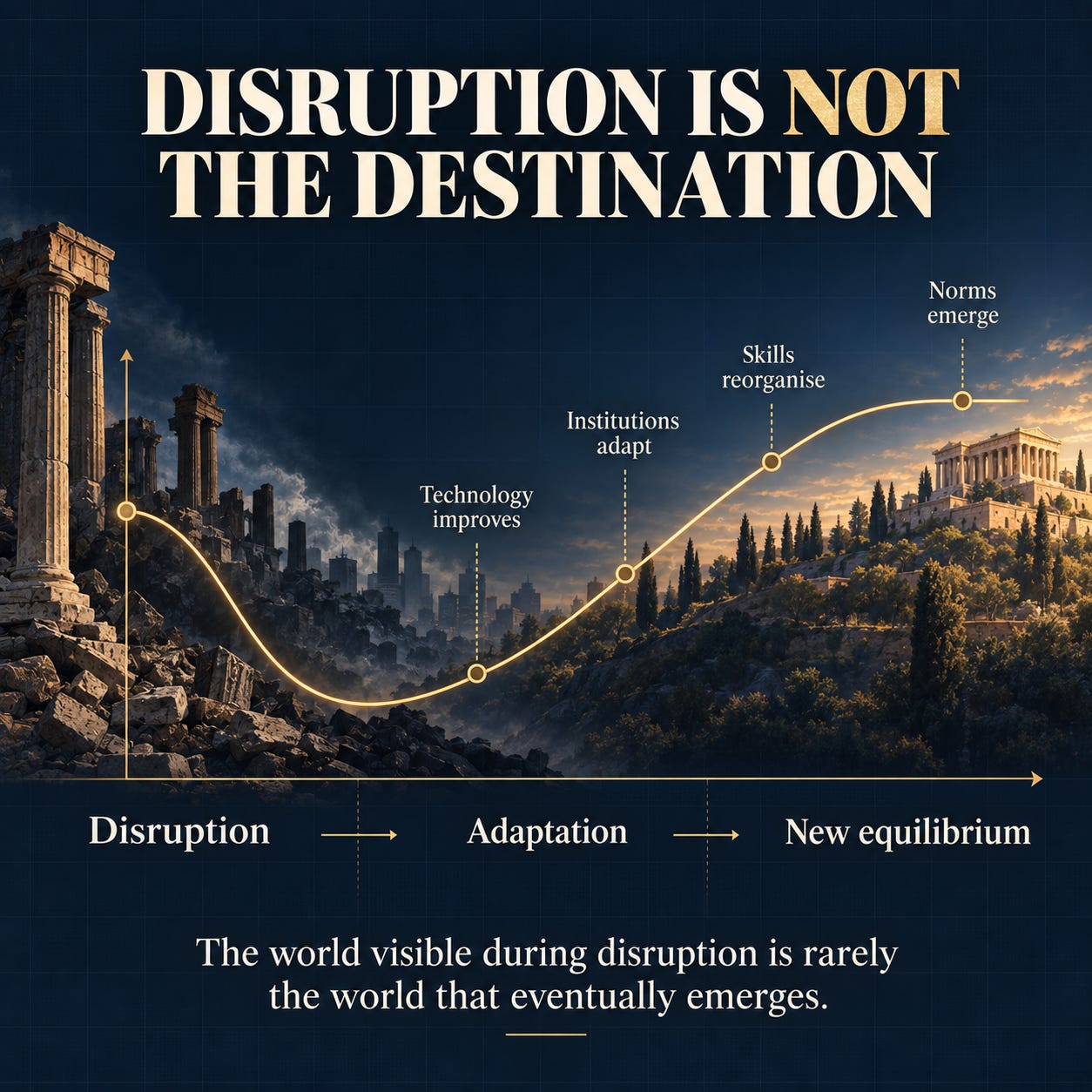
Socrates could see what writing might take away. He could hardly have anticipated a civilisation organised around accumulated written knowledge.
Early farming communities could see disease, harder labour and unreliable harvests. They could see rather less of the cities, institutions and technologies that settled civilisation would eventually support.
The first automobile was judged against the horse.
The early internet was judged against the newspaper and the shopping mall.
AI is currently being judged against the way humans work today.
That may be the wrong comparison.
AI will almost certainly alter today’s world substantially. The more useful questions concern what humans will build around it, which capabilities will become more valuable, which ones we will preserve deliberately, and which costs we will decide are unacceptable.
Humans have rarely entered technological revolutions gracefully.
We resist. We exaggerate. We underestimate. We regulate late. We adapt unevenly.
Then, quite often, we redesign society around the very thing that once appeared to threaten it.
The habit worth examining may be our confidence that we can already see where the change ends.